Thursday, January 18, 2024

New articles published for January 2024

Last week was spent in New York at the 2024 Baker Street Irregulars 'weekend' which takes place annually to roughly coincide with a date designated as Sherlock's birthday (https://bakerstreetirregulars.com/2023/10/16/plans-2024-bsi-weekend). Last year I wrote a summary of the weekend that was published in the The Passengers' Log (https://221bcooee.blogspot.com/2023/06/bsi-weekend-review-2023-published-in.html). I might write up a short summary of the events I attended in the next week or so with some fun photos, but the 2023 article stands as an overview of the delights and friendship on offer. The BSI interactions certainly stimulated some ideas for me, and I'll have a few posts on the coming weeks!

This post is intended to highlight two new very different articles I've written that have been published in the past few weeks.


The Arthur Conan Doyle Plaque of Adelaide
Matthew D. Hall and Bill Barnes
in The Passengers' Log, 8th October 2023, Volume 27 No 1
Available from: Sydney Passengers membership/subscription

This article was written in collaboration with Bill Barnes, and was originally a blog post from my visit to Adelaide in July 2023: https://221bcooee.blogspot.com/2023/07/the-arthur-conan-doyle-plaque-in.html. Bill Barnes, the President (Captain) of the Sydney Passengers group provided a lot of the historical context from his archives, and also provided an update after checking with the Adelaide Sherlockians. The article evolved from the original blog post, but that's the purpose of the blog, to put together short posts and pieces that can ferment and evolve over time into something publishable (or... just remain a blog post in most cases!). At six and a half pages, this article is certainly longer than any article I ever imagined writing about a plaque, but it was while working with Bill that we realized that there isn't an article on the plaque published anywhere in the Pasengers' Log, so that provides a historical record for... errr... the record.

Membership in the Sydney Passengers includes a subscription to this wonderful journal (or log) three times a year: http://www.sherlock-holmes.au/Membership.html - I really recommend it!!


Seeking Relief in the Canon
Matthew D. Hall
in The Sherlock Holmes Review, 2023 Sherlockian Annual
Available from: wessexpress.com

This article is a little whimsical, but underneath it is a seriously written and researched. It is also the first Sherlockian article I ever wrote. As the Review is an annual publication, and as this was accepted in January 2023, I've been twiddling my thumbs excited for my first article to be published, even if it has been bypassed chronologically by other things I've written :)

The article addresses the total absence of toilets in the canon - not mentioned, not used, not located. The idea came as I reflected on the mundane aspects of everyday life that even Sherlock must conduct - and of course this includes going to the bathroom. I wasn't sure about the idea, but at the very first Sherlockian meeting I attended - the 2022 BSI Conference at Bear Mountain NY - I was encourage to start writing (see below). It took a few months to gather the references (i.e. buy the rare books to read the articles) to make sure I'd covered all bases. My article definitely takes a light-hearted view and identifies several moments in the canon where - when reading the correct way - we can catch our characters in the act. 

One quote from the article perhaps helps to set the stage and tone:

"Across fifty-six short stories and four novels in the canon I have been unable to identify any direct reference to the use of a toilet or chamber pot, nor any visit to an outhouse, for what we may coyly refer to as number 1s or number 2s. Furthermore, a survey of many illustrations of the canon (Mike Foye, ’Sherlock Holmes: A Study in Illustrations Volume II ; Nicholas Utechin, ’The Complete Paget Portfolio’ ; BSI Manuscript Series, 'G.K. Chesteron’s Sherlock Holmes’) revealed no toilet, outhouse, or chamber pot in any illustration."

Those who know me will not be shocked at the topic, but having selected the topic I assure you that I researched the topic throughly! The Review itself is a fantastic publication - and this one features Brett on the front cover and several articles celebrating the 40th anniversary of the Granada series on Holmes, so there may be quite a few eyes on my article once people get through the 'good stuff'.


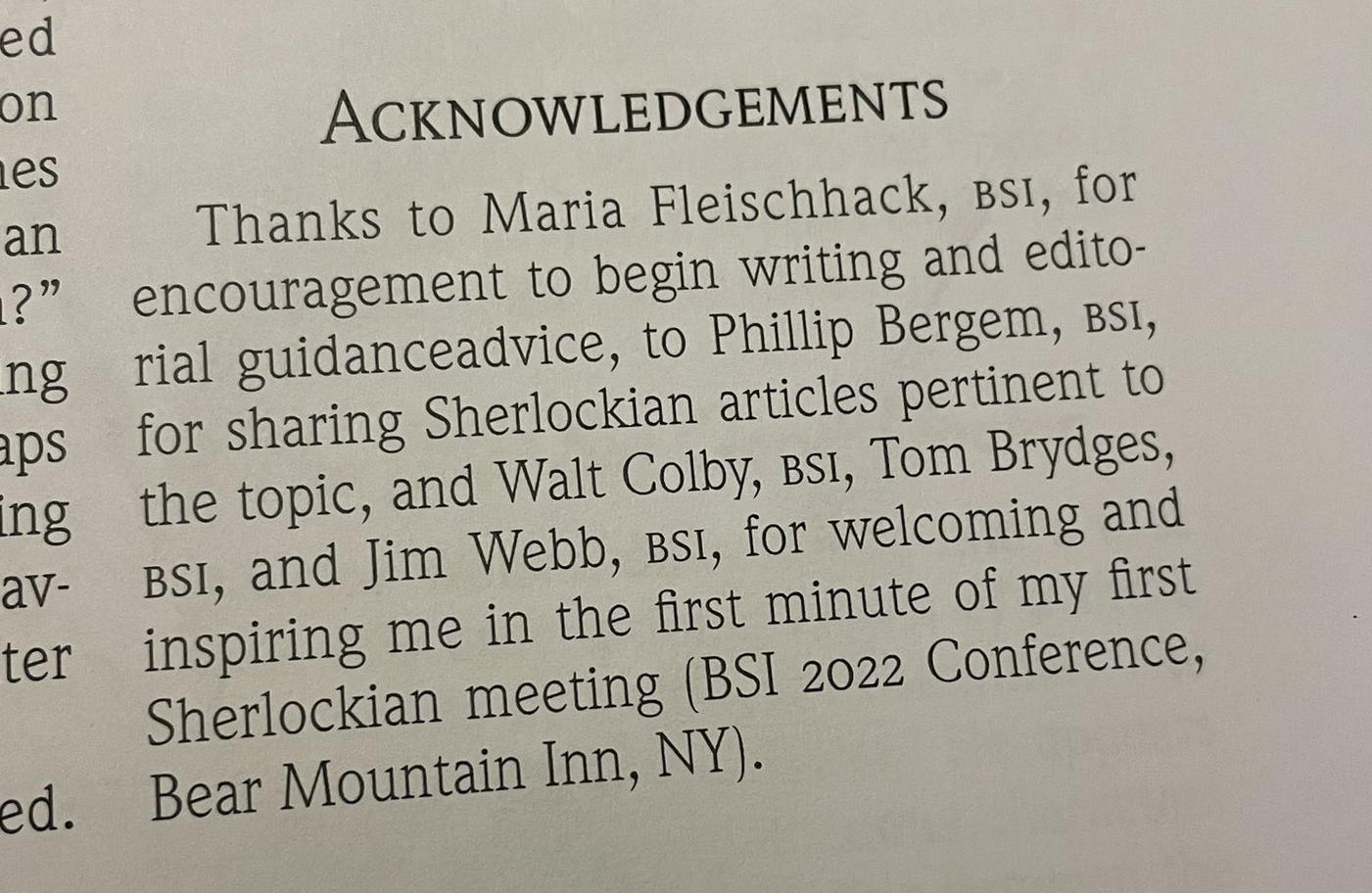
One important part I do want to highlight is my acknowledgements section. Maria Fleischhack spent time with me at the 2022 BSI Conference encouraging me to 'just start writing'. I was genuinely overwhelmed by the content of that conference, and couldn't imagine how I could possibly come up with anything 'new'. Maria also proof-read the article and provided comments for me. Phil Bergem was an incredible help, finding and providing articles he and others had written, and brainstorming on how to make sure I'd read the material out there on the topic of toilets and bathrooms in the canon. 

And finally, at my very first ever Sherlockian IN PERSON gathering (because I went to a lot of Zoom meetings during COVID), I walked into the Bear Mountain Lodge for that 2022 BSI Conference very intimidated. Everyone knew everyone and I knew no-one. I registered and walked up to the bar thinking I'd sit on my own and have a beer to calm my nerves. I didn't make it to the bar as Jim Webb introduced himself to me, then introduced me to Walt Colby and Tom Brydges, and the three of them invited me to join them for dinner. I went from nerves to welcomed in an instant and we had a long dinner and chat. I now know that their hospitality is not uncommon among Sherlockians, but I'll never forget their kindness to me. It was wonderful to see Jim and Walt last week at the 2024 BSI meeting, and while I sighted Tom we didn't get a chance to chat.

For them, I added this acknowledgement to my very first Sherlockian article:


Sunday, January 14, 2024

My Musgrave Monograph monomania - second version

This is a second updated version of my post on the Musgrave Monograph series. It includes some extra information and covers of all monographs I've been able to source. The first versino of the post can be found here: https://221bcooee.blogspot.com/2023/10/my-musgrave-monograph-monomania.html


My favorite scion publications come from the Northern Musgraves. Sadly, the Musgraves wound down 15 years before I discovered Sherlockiana. There were two primary periodicals published by the Northern Musgraves. The first was a regular newsletter called "The Ritual", and the second an 'annual' titled "The Musgrave Papers". Both publications contain absolutely outstanding Sherlockian articles, and many issues can easily be purchased on sites such as eBay.

There were a number of other Northern Musgraves publications. My favorites are the "Musgrave Monograph" series. Each publication is a short monograph on a single topic. While visiting New York I was lucky enough to spot a copy of the first Monograph at Otto Penzler's Mysterious Bookshop, and have now added a photograph. Please let me know about errors or other information you might have for this list - I've cobbled the list below together and have not found a complete list anywhere including in Northern Musgraves publications. The Northern Musgraves publications do carry announcements and reviews of the Monographs and I'll add some of that information. 

The Musgrave Monograph Series as currently determined.

Musgrave Monograph Number OnePacing The Musgrave Ritual, Carol Whitlam, 1990. Fifty copies issued.


{No picture of cover found}

Musgrave Monograph Number TwoDiving down into the cellar : uses of photography in the canon, Matthew Booth, 1991. This cover image was provided by Matthew Booth, and is the original artwork by Kathryn White (one of the co-presidents of The Northern Musgraves).


Musgrave Monograph Number Three"Ready when you are, Mr. Rathbone" : a review of the Universal Holmes films, Roger Johnson, 1995.

Musgrave Monograph Number Four'I looked in at Mecca ...': an insight into Sherlock Holmes' visit to Mecca, Anne Jordan, 1993. Reviewed in 'The Ritual' No 12 (Autumn 1993): "Anne divides her monograph into two sections: why Holmes might have wanted to visit Mecca, and, having arrived there, what he would have discovered... maps and illustrations are included in the text".

Musgrave Monograph Number Five140 different varieties : a review of tobacco in the Canon, John Hall, 1994. Reviewed in 'The Ritual' No 14 (Autumn 1994): "John Hall has managed to pull together all references to smoking, tobacco and other related topics in the Canon with consumate skill... there is also background information about the social attitudes to and practice of smoking, along with sections on Holmes the smoker, Matches, Snuff, Transport and Storage. 

Musgrave Monograph Number Six. The Misadventure of the Sherlock Holmes Pilot. An account of the making of the first pilot film for a Sherlock Holmes television series. Richard Launcelyn Green. 

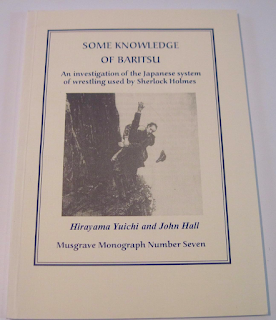
Musgrave Monograph Number Seven. Some knowledge of Baritsu: An investigation of the Japanese system of wrestling used by Sherlock Holmes, Hirayama Yuichi and John Hall, 1996. Reviewed in 'The Ritual' No 19 (Spring 1997): "Two leading Sherlockian writers.... review the various fighting techniques of jujitsu, bujutsu, aikido, sumo, bartitsu, and judo, and the influence of Japanese wrestling in Victorian London.... The monograph begins with a consideration of the possibility that Holmes may have visited Japan".

Musgrave Monograph Number Eight. Sherlock Holmes, Conan Doyle and the British Empire : an investigation into Conan Doyle's links with the British Empire as expressed through his Sherlockian and other literature, Jeffrey Richards, 1997.


Musgrave Monograph Number Nine. 221 BBC : writing for the world's first complete dramatised canon : (with some observations upon previous radio appearances of Mr. Holmes and Dr. Watson), Bert Coules, 1998. Reviewed in 'The Ritual' No 23 (Spring 1999): "His account begins with a thoughtful analysis of the radio careers of Holmes and Watson both in Britain and America up to the time of his own involvement. This began in 1987... Coules proceeds to give us a revealing and instructive insight into the making of radio plays."


Musgrave Monograph Number TenThe somnambulist and the detective : Vincent Starrett and Sherlock Holmes, Susan Rice, 2000. Reviewed in 'The Ritual' No 27 (Spring 2001): "Rice has provided a fine overview of {Starrett's} five major Sherlockian works.... there are also assessments of Starrett's involvement in Chicago scions.... the monograph is rounded off by a comprehensive, if not exhaustive, Starrett bibliography".


NOT A MONOGRAPH

I'll also add a few publications here from Musgrave Monographs that are also chapbooks, but turn out to be one-off publications, rather than part of the 'Musgrave Monograph' series.


Sherlock Holmes and the Shadow of the Wolf. Ron Weighell, 1992. This is a pastiche, rather than a Sherlockian study. From Wikipedia: "In 1992, the Northern Musgraves... invited Weighell to produce a story for their ‘Aspects of Holmes’ weekend. The positive reception of The Shadow of the Wolf, read out at the society's annual dinner."

{No picture of cover found}

Guilty of several monographs : the published writings of Mr. Sherlock Holmes. John Hall, 1996. Given that other number is accounted for, it is possible this title was not part of the Monograph series.


Tuesday, January 9, 2024

Geographica Baskervillia. A rare publication? Maybe, maybe not.

I've been doing a LOT of Sherlockian reading on the Hound of the Baskervilles. There are a few reasons for this. It's certainly my favorite Sherlock story! I was lucky enough to visit Devon and the moors district for a day during the past summer including Buckfastleigh and the Cabell sepulchre (see information here : https://221bcooee.blogspot.com/2023/08/richard-cabells-sepulchre-in.html). Another reason I've been reading through articles and books stiuying HOUN is because I'm researching and writing a Sherlockian article... of course my goal is that it would be published in an eminent journal, but I recognize that I'm not amazing at writing 'studies' and we will see what happens. Anyway I'm reading a lot!!

That Cabell post mentioned above includes a list of HOUN studies, with my absolute favorite being The Hound of the Baskervilles, Hunting the Dartmoor Legend, by Philip Weller, and published in Devon, 2001. In my opinion the book is an absolute tour de force covering every aspect of the HOUN story, ACDs sources and inspirations, the Dartmoor setting, and color photographs of the Cabell sepulchre. I cannot recommend this book enough, and it includes the HOUN story itself. I should add there is a STRONG emphasis on identifying the real geographic locations in which the HOUN is set.

A lot of material has been published by Weller, and in seeking other studies by Weller that might exist on my obscure HOUN-related topic, and innocent search at Abebooks.com unearthed this publication, in a three-ring folder, of about 170 pages.

Geographica Baskervillia, A Dartmoor Workbook

Compiled by Philip Weller 

from The Hound of the Baskervilles

Published 2000


As can be seen above, the folder includes a cover letter that outlines the notation strategy. The 'Dartmoor Sherlock Holmes Study Group' appears to have been a sub-group of the Franco-Midland Hardware Company - a British society. A sample of Weller's textual analysis of location is shown below. It is incredibly detailed, with each phrase highlighting any locatino comments in purple, followed by commentary in green. Line by line!


The folder and document itself doesn't provide a great deal of detail on the context or background to this publication. Nor does the 'volume' provide any insight into the 'print run' for this compiled folder.

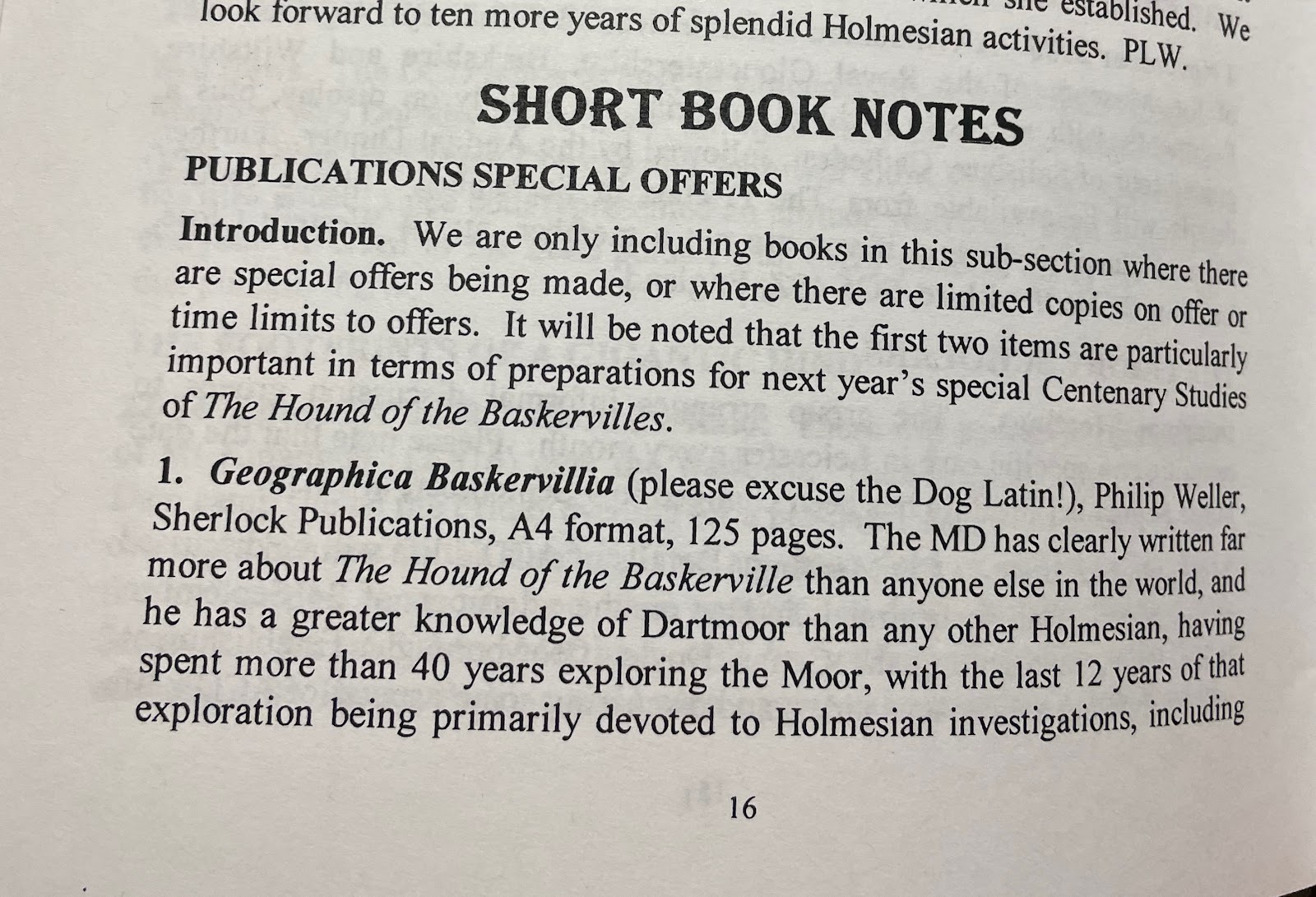
I turned to the publications of the Franco-Midland Hardware Company (FMHC) to find some information. I believe that Weller was the head of the FHMC (called the Managing Director of FHMC), and it published a dizzying number of different publications - including a "Memo" and "Newsletter" and a "Report" series. Sure enough, the August 2000 issue of the 'FHMC Memo' includes notes on books, including the Geographica Baskervillia. I've pulled out some quotes from the publication announcement in 'The FMHC Memo' for August 2000 (issue 7). As a side-note, my copy of the August 2000 Memo has an insert from 2002 apologizing about inactivity in publications of the FMHC.


Bolded emphasis in the quotes below are mine:

"The MD (Weller) has clearly written more about HOUN than anyone else in the world, and he has a greater knowledge of Dartmoor than any other Holmesian, having spent more than 40 yeras exploring the Moor, with the last 12 years of that exploration being primarily devoted to Holmesian exploration, including visits being made to every single building on the 369 square miles of the Moor... 

"Some of those taking part in the Hound Centenary Convention on Dartmoor have asked for copies of the MD's own special reference work on the canonical references to locations in the HOUN. This volume consists of 120 large-format (A4) pages and 50,000 words of text. Some 375 quotations are extracted from HOUN, each of which provides a clue to the geography of the case. The nature of the clue, or clues, in each quotation is/are discussed and cross-linked to other quotations bearing upon that aspect of the geography, and to real locations on Dartmoor which may have inspired the quotation. This is done using colour codings and page references to the Doubleday and Oxford editions of the case.

"It would be prohibitively expensive to have this material printed commercially, because of the colour-coding, but we are willing to produce copies of this unique reference work directly from a computer printer at cost price, for storage within a loose-leaf filing system. This is, in any case, the best way of storing this material, to allow for updates and the inclusion of other material. A lot of preparatory work will be required to set up this project, and we are only going to make this offer once, so this is your only chance of obtaining a copy of this work

"Please note that we originally had no intention of publishing this material, as it really is a labour of love, which has involved many thousands of hours of work to produce, so we really do not mind if nobody actually wants a copy.


This announcement provides context for the incredible research and effort that Weller put into his 'passion project'. How many people purchased copies? I doubt there were many, as it was only announced once in the 'FHMC Memo', but I'm pleased to have one to add to my small collection of HOUN-related Sherlockian publications.

Friday, January 5, 2024

Ouch! A title page review of The Italian Secretary

The shortest of posts! Browsing the shelves at Second Story Books in Rockville, I chanced to open a used copy of the Sherlock Holmes pastiche 'The Italian Secretary' by Caleb Carr. I remember struggling through this book on a flight after buying it at Heathrow Airport back in the late 90s. Really struggling.

So I felt validated by the previous owner who had decided to annotate the title page of their book: "The characters are neither Holmes nor Watson. The language is not Watson's either".

Brilliant. The book is still on the shelf at Second Story Books, and may be for quite some time!  


Wednesday, January 3, 2024

The dancing miners and their photographer

This is a post that I absolutely intend to evolve into a Sherlockian article somewhere.

The BSI International Series book "Australia and Sherlock Holmes" (https://bakerstreetirregulars.com/2009/01/04/australia-and-sherlock-holmes) contains an introduction by Bill Barnes and Doug Elliott highlights a wonderful Australian Sherlockian event - one of the first Sherlockian gatherings ever! 

The monthly Strand Magazine contained a delightful section titled 'Curiosities' that printed a range of submitted photos and anecdotes from readers. The August 1904 issue of the Strand leads its Curiosities section with a Sherlockian submission:


Curiosities

WHAT IS THE NAME OF THE MINE? Some miners in Australia have adapted the cipher of "The Dancing Men" given in the Sherlock Holmes story published in THE STRAND MAGAZINE for December, 1903, and have spelt out the name of their mine as shown in the photograph. Can our readers give the name of the mine? The photograph was sent to Sir A Conan Doyle, Undershaw, Hindhead, Haslemere. 

Some very nice Sherlockian work has taken place around this photograph. A search of subsequent issues of The Strand Magazine did not unearth a follow-up to this article providing the answer.

The excellent Passenger's Log journal first published two Sherlockian pieces on this photograph, in issues 6.3/4 (May/August 2003) and 7.1 (October 2003). These articles first examined the human cipher, showing that they people corresponded to 'LACESIGE'. There was no 'K' present in the original canonical cipher, and it is assumed a hard 'C' was substituted providing us with 'LAKESIGE'. The 'G' is in fact meant to be a 'D', with the two letters have mirrored cipher symbols. And so we have 'LAKESIDE'.

Discussion in the Passenger's Log articles in 2003 next turn to where this mine could be. There was a mining town or settlement of Lakeside near Kalgoorlie in Western Australia (which was a very active gold mining centre in 1903), and it was also found that a mine in Ballarat, Victoria was called Lakeside. 

More recently, the 'Baker Street Almanac' issues (which can be freely read here at http://www.greenbag.org/almanacs/BS/bsa.html) have included an annual update of activities from 'other' countries. The report for Australia in 2019 and 2020 by Bill Barnes makes a more categorical statement that "there was indeed a gold mine named Lakeside in 1903, near Kalgoorlie in Western Australia."

The articles also pointed out that the photograph represented one of the earliest known organized Sherlockian events. It also represents one of the first every Sherlockian photographs. If we look closely at the Strand article, we see one extra detail:


"From a Photo by H. Grose."

Who was H. Grose? If we can identify the photographer, we should be able to confirm the location of the mine.

While a fuller summary will ultimately be written up, the answer is that our photographer is Henry Hermon GROSE (sometimes spelt Herman). Around the time the photograph was mailed to ACD (early 1904), the following advertisement was placed:

 Kalgoorlie Miner (WA : 1895 - 1954)  
Mon 19 Oct 1903 


Henry photographed under the name "H. H. Grose", and his studios in the Western Australian gold-mining town of Boulder (adjacent to Kalgoorlie) were immediately next to the now-ghost-town of LAKESIDE. In 1946, to location of Lakeside was officially re-named to Lakewood. 

The Kalgoorlie region was harsh and remote, established during the 1890s. How harsh and remote? Here is Lakewood (Lakeside) today from Google Maps Satellite:


Henry Grose, our photographer, was born in Adelaide (South Australia) in 1874. In 1895 he arrived in Fremantle (near Perth) from Adelaide on the ship 'Rockton', and may have headed straight for Kalgoorlie/Boulder which was in the early day of a gold rush. In 1901 he was in Boulder, as the announcement of his wedding and confirmation of his wedding shows:

The Evening Star (Boulder, WA : 1898 - 1921)  
Fri 4 Jan 1901


In 1901 a book of panoramic photographs called "Boulder city and views around West Australia's great gold centre" was published by Orr's Emporium, using photographs taken by Grose. A newspaper article described the book thus: "The panoramic views... are probably the best ever taken in the district, and the other photographs all bear testimony to the skill of Mr. Grose".

Critically, Grose had many photographs of mines, batteries (used for crushing quartz to extract gold), and employees of mines, published in newspapers - the first in 1899 and the last in 1903 (with one exception of a garden photo in 1907). These published photos are all labeled with the "H. H. Grose" credit, and include at least one photograph of mines at Lakeside (the Leviathan Battery and Cyanide Plant, Lakeside):

 Kalgoorlie Western Argus (WA : 1896 - 1916)  
Tue 22 Apr 1902

Other photos of workers at the Leviathan by Grose may include our Sherlockians!


It appears that shortly after Grose took the 'Dancing Miners' photograph, he went out of business and became bankrupt in 1906. Grose may have abandoned commercial/professional photography at this stage - there are no further references to his photography, and some possible references to working in mines. It's also evident that Grose was a mason from notices in the newspapers, and a member of the Surface Workers Union (a mining union).

Henry had at least five children, two of whom were 'deaf-mute' according to newspaper articles.

Henry Grose died in July 1918, aged 44, and was removed from his home at No. 1980 Vivian-street, Boulder and buried at the Boulder Cemetery.

UPDATE: A kind member of 'Find A Grave' named Danelle Warnock went to the site and provided the two photos confirming there is not headstone for that plot (as is the case for most around). After Grose died, his wife and children relocated to the Perth area, which may explain why a gravestone was not later installed.


Left: Wide view of the grave plot. Right: The metal plot marker '618' is all the marks Henry Grose's grave.

I would be very happy to hear from anyone who comes across this blog post, with more information, or photographs taken by H. H. Grose of Boulder.


Sunday, December 24, 2023

Peter Blau and the future of the Sherlockian world

One of the very first blog posts I made described the presentation by Glen Miranker BSI at the Red Circle of DC. You can read more about Red Circle meetings at the official site (http://www.redcircledc.org) and for each meeting you can see Peter Blau's notes on each meeting.

At the June 2023 meeting of the Red Circle, the intended presenter was the actor Paxton Whitehead (https://en.wikipedia.org/wiki/Paxton_Whitehead). Sadly, Paxton passed away just days before the meeting, and the illustrious leader of the Red Circle, Peter E. Blau BSI, stepped up and presented. I'm embarrassed to say it took me six months to organize the recording into a formatted presentation and my good friend Kyle Brimacombe created a formatted recording. That recording has now been posted on Youtube, and is embedded into the blog post below.

The presentation itself includes a lovely introduction from Beverly Wolov and Ross Davies BSI. They are costumed in Peter Blau's trademark powder blue blazer and tie embroidered with "Snoopy the detective" (created by Bev Wolov specifically for Peter). 

 
Left: Ross Davies and Bev Wolov dressed as Peter and introducing Peter. Right: Close-up detail of Peter's hand-embroidered signature tie.

Peter's talk was entitled "The Future Lies Ahead" and recalls his more than six decades as a Sherlockian. It's a very enjoyable talk and worth watching both for the content and for an opportunity to see Peter's personable and comedic style.

 The video can be accessed directly at : www.youtube.com/watch?v=egBds8GZVus  

Wednesday, December 13, 2023

The first generation of Baker Street Journal Christmas

The Baker Street Journal (BSJ, which you can subscribe to at https://bakerstreetirregulars.com/the-baker-street-journal) publishes four regular issues each year, and a 'Christmas Annual' (a fifth issue). In the 'modern era' (if that's a thing) the Christmas Annual has been produced each year since 1998. Each Christmas Annual is a special issue that focuses on a single topic. A complete list of issues from 1998 to the present time can be found at the BSJ site (https://bakerstreetirregulars.com/bsj-christmas-annual). This series of Annuals from 1998 to present is actually the second time Christmas Annuals have been published by the BSJ.

Edgar J. Smith launched the BSJ in 1946. The BSJ didn't survive long and failed in 1949, but was relaunched in 1951 and continues to this day. Under Smith's editorship, the BSK released five Christmas Annuals, the first being in 1956, and the fifth and final being published for 1960. The original Annuals contained collections of articles (not too dissimilar from a typical BSJ issue of the time).

I recently managed to pick up a set of this original set of Christmas Annuals at Second Story Books in Rockville MD.


 Each issue carries a near identical cover design with a different color, with a design replicating that of the 1887 Beeton's Christmas Annual that carried the first Holmes story. The concept of the BSJ Christmas Annual is inspired by the Beeton's Christmas Annual issue that is central to the history of Sherlock Holmes publishing, and also captures the mystery of such a rare and valuable issue. 


The opening of the 1956 (first) and 1960 (final) Christmas Annuals capture the inspiration for the launch of the special issues, and also the reason for their termination. I've decided to transcribe those pages here. 

First is the editorial that opened the 1956 issue:


1956 Christmas Annual
The Editors Gas-Lamp
TO MRS. BEETON
It is to Mrs. Beeton that the glory belongs. Some time, somewhere, in middling-to-late Victorian England - though the record sheweth not the date or place - this good lady, who is known to us only by her unadorned surname, conceived the idea of catering to the tastes of her more sensationally-minded countrymen by offering then, once a year, for the small sum of one shilling, a shocker given over to the celebration of gore and low adventure. She called her little paperback - in deference to the time of year at which it appeared, surely, and not because of any beatific attributes in its content - a Christmas Annual; and it was, on all the evidence, a thumping success both of esteem and of the fisc. For we know that it found its way, after not too long, into the hands of the highly respectable publishing firm of Ward, Lock, & Co., of London, New York and Melbourne - if, indeed, it had not been there from the beginning.

We are sentimentally and curiously concerned with the early history of Beeton's Christnmas Annual only for the reason that we know so little about it. The important thing is that, in the year 1887 - but which time Mrs. Beeton herself may have become merely the editor, or no more than the fiction and symbol of sponsorship she had perhaps always been - Ward, Lock & Co. accepted, in behalf of the magazine, a tattered and often-rejected manuscript submitted by a young doctor who had never made much of a success of his profession, and thereby launched him on a career that brought wordly fame to him and unworldly ecstacy to prcessinoal generations of his readers. There were other tales to come, and other publishers to nourish them and profit by their ineffable popularity; but the glory is, and ever will be, Mrs. Beeton's. It was she, or whoever she stood for, who had the courage and the vision t ogive to mankind A Study in Scarlet - and with it Sherlock Holmes.

By the process of a literary mutation with which the botanical world is unfamiliar, this Annual has become a perennial. It stands as the cornerstone of every respectable collection of the first editions of the writings of Dr. John H. Watson. Is is as fresh today as it was on that December day sixty-nine years ago when it was first put forth. Its excessive rarity gives it a worth multiplies its intrinsic worthiness, and its fading pages convey a sense of the time and place in which the Lauriston Gardens mystery occurred that not other pages, however beautifully printed, can possibly provide. It is, for Sherlockians, the book of Genesis.

To publish a Christmas Annual inspired by Mrs. Beeton's is a temerarious undertaking. The cover is in simulation - and there can be no doubt, but the way, as to who the man rising from his chemical table to light his gas-lamp really is - even if the contents are not. But even if there is no new tale of Sherlock Holmes included in the text - along with two "original drawing-room plays" - there is, at least, good talk about the Great Detective and the things he said and did, and the JOURNAL is proud and happy to present its own Annual to a world which is, we hope, prepared for it by the example Mrs. Beeton set.


And so we are left to ask what caused the end to the Christmas Annual after 1960? The answer lies in the black-bordered opening to the 1960 issue announcing the death of Edgar Smith (with an opening sentence lifted from a Holmes story as tribute). The following page opens ATTENTA! and reveals that the 1960 Christmas Annual was compiled from the material prepared by Smith.


1960 Christmas Annual
In Memoriam
Edgar Wadsworth Smith
1 April 1894 - 17 September 1960
It is with an unusually heavy heart that I have to record the loss of hom whom I shall ever regard as the best and wisest man whom I have ever known. As we of the Baker Street Irregulars turn down an empty glass for him, it is not only sad, but it is also extremely difficult to believe that we have stood out on the terrace with him for the last time and have had our last quiet talk with Edgar Smith.

To the world in general Edgar Smith was known as one who had achieved great success in the field of business. Those who were acquainted with him found him also to be a man of profound scholarship. But we, who were fortunate enough to know him well, realize that he was that rare paragon - a perfect gentleman and a real scholar with the gift of evoking sincere friendship.

His activities led him into many fields, and there is nothing he touched that he did not improve. Certainly, there is no one who can take his place. We have lost the truly indispensable man, and we cannot expect ever to look upon his like again within our lifetime.

"Si monumentum quoeris, circumspice"
JW, M.D.


1960 Christmas Annual
ATTENTA! ATTENTA! ATTENTA!
A Notice to the Readers of The Baker Street Journal
THERE WILL ALWAYS BE A JOURNAL!

This issue was prepared by Edgar W. Smith, the only editor the Journal ever had up to the present time. Practically all of the material was selected and typed by him, and was found among his papers.


And so the BSJ did live on, but from 1960 till 1997 the Baker Street Journal Christmas Annual was not produced, till it emerged again as a fine tradition from 1998 onwards.


NOTE: One of the copies above lists a price on the cover. I'm too scared to 'erase' it, but it is certainly NOT the price I'd have paid (or could pay, for that matter) for this set!

Tuesday, November 28, 2023

Tucked in a book - the Abbey National brick receipt

My favorite thing to post about are small personal connections in books that I find (see for example this post on Gisela Seligmann). 

Today I had a chance to drop by the wonderful Second Story books and spied this innocuous and non-valuable book: The Return of Sherlock Holmes containing HOUN and the Return short stories is facsimile directly from the Strand Magazine. It was published in 1995, the second of three volumes published by  

The first thing I do is look to the fly leaf and title page to see if there's an owners signature, or ex libris note, embossed library mark, address stamp, etc. In this case there were none of these, but it was a cared for book, with a mylar wrapped on the dustjacket.


But tucked in the inside jacket was a small piece of ephemera that could appear meaningless to an innocent book-buyer. It is a small booklet from the Abbey National, a British Building Society ( a form of bank). This bank was headquartered on Baker Street in the address range covering 221, and for many years received and responded to letters addressed to Sherlock Holmes. The pamphlet includes a small section on Baker Street, a card-sized map of the London tube, and a receipt. Let's take a look at the receipt...


The receipt is dated 13 May 1981, and is from the Abbey National Building Society on Baker Street. This is a bank teller receipt, but instead of a bank account number, it states "BRICK" with a price of 2 pounds sterling. Ah if only there was a brick tucked in this book. What brick?


Well earlier this year the 'Curious Collection of Robert Hess' was auctioned (Part 1 anyway), and among the items was the brick shown below. The description states 'A near fine example of this unusual piece of Sherlockiana. In the 1980s, 221b Baker Street was part of the Abbey National Building Society headquarters. When they decided to re-build the offices, several of the better bricks were set aside and sold to collectors in specially designed boxes, with the proceeds going to charity.' 


And so, the owner of this book in Maryland also owned the brick, purchased in London and lugged back in a suitcase to the United States. Certainly a unique piece of memorabilia. I actually tried to buy this brick was beaten by a larger waller on the day! I'll keep looking for a brick.

The nice coincidence is that the very latest Jeremy Brett Sherlock Holmes podcast on the Granada series (http://sherlockpodcast.com) the discuss a very short video created by the Granada team for Abbey National. No explanation exists for why this video was created, but perhaps the Abbey Treasure was a brick....

Trust me I'm a doctor

I've been looking at advertisements that leverage Sherlock Holmes, mainly articles on Beecham's pills (being published in the near f...