Saturday, February 10, 2024

Dorothy Violet Bowers, novelist (1902-1948)

I published the following post in August 2020 on a blog I keep for random genealogy/history research (https://randomfh.blogspot.com/2021/07/dorothy-violet-bowers-novelist-1902-1948.html). Given that I now have a 221B blog post for (mainly) Sherlockian activities, I've decided to review and revise that post and share it here. Since this blog post, there has been one or two other articles on Bowers the leveraged a lot of information from my post, including this podcast (https://shedunnitshow.com/themysteriousdorothybowerstranscript). I've continued to look for information on Dorothy, but really not had any luck adding to the original post. Nevertheless I've reviewed the blog post and added one or two pieces here. I have still not found a photograph or grave for Dorothy.


I am enamored with the mystery writing of Dorothy Bowers (1902-1948). Bowers published five ‘golden age’-style mystery novels in a career interrupted by World War 2, and died aged 46 in 1948 from tuberculosis, shortly after being inducted into the famed Detection Club. Several web sites state that Bower died with the "satisfaction of knowing that she had just been inducted into the Detection Club", though the nature of Bower's engagement with members of the Detection Club isn't known.

I have found little biographical information on Dorothy’s life, and as far as I can ascertain, no photo of Dorothy is known to exist. I cannot identify where she is buried (or rather, the fate of her remains). I also desired to know what happened to Dorothy’s estate and any unpublished writings or draft manuscripts from her novels. Did Dorothy publish murder-mystery short stories? If not, why not?

I hope this post can stimulate the creation of a Wikipedia page for Bowers also.

I pieced together this post with the primary sources I could find as a starting point, and hope others that find this can point me to archives or resources. I spent a significant amount of time looking into probate, death certificates, and cemetery records, in the hope I could trace the family, and clues to living family connections.

While this post won’t describe or critique Bowers’ writings, the five novels she published were:
- Postscript To Poison (1938)
- Shadows Before (1939)
- A Deed Without A Name (1940)
- Fear For Miss Betony (1941)
- The Bells at Old Bailey (1947)

The first four novels featured the character Inspector Pardoe of Scotland Yard. When her fifth novel 'The Bells at Old Bailey' was published after a six year pause, and with a new Detective.

The best (only?) biographical sketch of Bowers appears in the 1948 book “More Monmouthshire Writers” by W.J.T. Collins (R.H. Johns Ltd., Newport, Mon, Wales). The book contains biographies of thirty-nine writers from Monmouthshire, some long-since deceased, and others (like Bowers) living at the time. One gets the sense that some biographies have the hand of the subject themself in their biographies, or are at least the product of material provided by the subject. In the Foreword, Collins defends the inclusion of “little-known contemporary writers” in the volume as “I feel they deserve recognition and such remembrance as an anthology gives when the original works are “out of print” or forgotten except by faithful friends or relatives”. The entry on Bowers contains extensive quotes from Bowers’ work, and I have created an abbreviated summary of that chapter here (primarily excluding literary discussion, to focus on biographical details):

Dorothy Bowers
    Monmouthshire claims Bowers by reason of lifelong association. Born at nearby Leominster (Herefordshire) on June 11, 1902, a hunger for knowledge and love of the printed word was in her blood, inherited from her paternal grandfather, a shoemaker, whose passion for reading remained always unsatisfied because he could not afford to buy the books he craved. So great was his longing for reading matter that he would retrieve any blown piece of newspaper that came his way and, however torn or soiled it might be, fold and brush it carefully, lovingly, that he might at pleasure feast even on a fragment of the printed word. This passion for reading he transmitted to his son, Albert Edward Bowers, and Miss Bowers' earliest memories go back to the exciting and catholic jumble of books that was her father’s library - a monument to his self-denial of other indulgences as it was to the range and discrimination of his literary explorations. It is interesting to note that this collection included early and much-thumbed editions of Sherlock Holmes stories. With such an ancestry - her mother too comes of a family whose individual members revealed, without the opportunity of developing it, uncommon creative talent in drawing and painting, -and such an environment, it was natural that from early years Dorothy Bowers set herself to become a writer. She was a year old when her father settled in Monmouth, whose woods and meadows, rivers, and birds and old stones, have shaped, she says, so much of her mental and spiritual life. There he was in business till 1936, and in 1943 he died, one of the best-known, best-loved men in the town.

    Her debt to formal education is considerable. First, there was a French convent school, where she acquired method, precision, and an abiding delight in the orderly and formal arrangement of ideas, and even of material objects - a sense of pattern and symmetry. Monmouth School for Girls provided her secondary schooling, and to its teaching of history and literature she says she largely owes a sense of continuity that is at once an excitement and a consolation. She was a day girl there till she went up to Oxford in 1922, and as a member of the Society of Oxford Home Students (now St. Anne’s) read History and took an Honors degree in the School of Modern History in 1926. For a time she taught intermittently in a boarding scholar two, though not as a resident member of the staff for which she remains grateful ; was occasionally a relief teacher at her old school during absences of the regular staff ; was governess to a succession of children, and learned more, she confesses, from spasmodic and unsuccessful efforts at teach than ever she imparted, not least among the lessons that there was no occupation to be found she would not prefer to a teacher’s. She abhors and condemn’s the conventional life, not only in its academic manifestations, but any such life lived on a collective and monosexual basis. 

Her short story, “The Spy at Chateau Bas” was published in the now defunct “English Review” ; poems were published, and in 1938 her first novel was published. Early interested in criminology, and compiler of the more abstruse and cryptic type of crossword puzzles (for "John O’London's Weekly” 1936-1943, and for “Country Life” 1940-1946, during the absence in the Navy of their former crossword correspondent), it was not surprising that her creative powers turned to novels of crime and detection.

One of her hobbies is bird-watching, and she selects from the open book of nature and the clasped book  of the specialist a fact, a name, a parallel, which supplied on of the minor mysteries of “A Deed Without A Name,” and explains why one of her characters persistently drew and modeled the representation of a little-known bird.
    
Like many another creative artist, Miss Bowers found that the war cramped her powers, limited her opportunities, and diverted her from the chosen path. There was work to be done, however - in the Inquiries Bureau of the National Book Council (now the National Book League), in the European News Service of the B.B.C., and of course in the maze of crosswords. But when the war was over she started again, and her fifth novel was included in Hodder and Stoughton’s autumn list (1946). Poetry from her pen has appeared in “John o’London's Weekly”, “The Observer”, and the now defunct “Everyman”. Three of her poems have been included in “Saturday to Monday” (published by Newnes). 

Miss Bowers is a life member of the Society for Psychical Research ; among her hobbies are insect and plant life (her father was a notable amateur gardener) and the study of Seventeenth Century history and art. Though from the age of thirteen months, till a few years ago, Monmouth was her home continuously, she once confessed that her ambition was to live near Oxford and the Bodleian Library.


The biography above is rich in information, and was published in 1948, the year of Bowers’ death at 46 of tuberculosis. At the time she had been inducted into the Detection Club (not mentioned in the biography), though whether she attended a meeting is to be determined. A Pan Books softcover issue of "Deed Without A Name" was issued in 1948, and the biography on the back cover states Dorothy was elected to the "exclusive" Detection Club. 

And so, I’ll start with the end, and attempt here to complement the information on Dorothy’s career arc with primary records I can find on her life and family. Genealogic research reveals is that Dorothy had no children, and her two siblings likewise did not produce issue. So as her family line has ended, where did her photos, letters, papers, drafts, and diaries end up?

Bowers’ parents Albert Edward BOWERS (born Colwall Hereford) and Annie Marie DEAN (born Hereford City) were both English, married in 1896 in the Hereford registration district (that also embraces Monmouth). They evidently settled in Leominster, Hereford, as the 1901 census shows that Albert, a ‘baker and confectioner’ was operating on his ‘own account’, living at Etnam St, Leominster. Today, Etnam St contains a mix of residential and stores that appear largely original. Their first daughter Gwendoline Lilian was born in Leominster in 1897, and was aged 4.

1901 Census for Leominster, Hereford


By 1911, Annie and Albert had two more daughters. Dorothy Violet (second of three) was born in Leominster in 1902, and Evelyn May was born in Monmouth in 1904, by which time the family had moved there (Bowers’ biography claims 13 months of age, which fits). The birth records match with the 1911 census, where the family of five are living in a 6-room dwelling on Agincourt St, Monmouth, a dog-legged  narrow lane of stores. Albert's mother Anne was also living with the family.

1911 Census for A E Bowers, Agincourt St, Monmouth


We can find her arriving in Oxford, on "The Term's Freshmen Full List" as D.V. Bowers as part of the Society of Home Students in 1923. Women were first admitted for degrees at Oxford in 1920, and the Society was an association rather than a brick-and-mortar college, that allowed women to live in Oxford (in their own lodgings) and attend lectures. The Society evolved into St Anne's College at Oxford.

Oxford Chronicle and Reading Gazette - Friday 19 October 1923


Following here time at Oxford, the biography above indicates that Dorothy had several postings as a teacher, but ultimately returned to Monmouth with her parents.  In 1927, Bowers published the short story "The Spy of Chateau Bas" in the English Review (1927, p619).  It seems reasonable to assume that Dorothy's time at a French Convent School informed components this story, which is more espionage thriller than mystery. It also appears to be the only short story published by Bowers previous to her five novels.


The Daily News (London) for Wednesday 6th February 1935 ran a letter from Dorothy commenting on a quote by Gracie Fields, one of the highest-paid actors of the 1930s:

FEW people, one Imagines, will be impressed by Miss Gracie Fields's avowed preference for a cottage and 10s. a week to a salary approximately 3,000 times greater. The acquisition of so meagre a blessing ' as she desires should be within easy reach. The envied possessors of such would in most cases place no obstacle in the way of exchange. In the case of a film actress a distasteful £1,500 a week can be foregone by a moment's decision a bare subsistence wage. on the other hand. may not show one penny's increase by a lifetime's struggle. Since Miss Fields has made the "contract one must presume it is acceptable to her. Honest pleasure in it on her part would therefore be both more appropriate and more appealing. DOROTHY BOWERS. Westbury House, Monmouth.

Bowers was also publishing poetry, such as this piece in Devon's Western Morning News - Thursday 08 August 1935:


The next time-point identified for Dorothy was the death of her sister Gwendoline Lilian on 22 Feb 1936. Gwendoline died aged about 39 at the family home Westbury, Dixton Rd, Monmouth. As Gwendoline died intestate, it is possible she died with little warning, and administration of her estate was awarded to her father Albert.


Westbury House was a substantial residence, and remains in Monmouth, appearing to operate in 2021 as a child-care center.


With the initiation of World War 2, a civilian register was compiled in England & Wales, and Dorothy was entered living with her parents at Westbury. In 1939, Dorothy was single with the occupation "Author (Novelist)", which was indeed the case by that time, with Postscript To Poison published in 1938, and Shadows Before in 1939. Albert was now 70 and retired, and Annie was 69. 

1939 Register


Precisely where Dorothy lived during World War 2 is not clear, or perhaps it's more appropriate to say that Dorothy may have lived in multiple places.

Entries in Proceedings of the Society for Psychical Research for 1940-1946 list Bowers living at 7 Chester Avenue, Tupsley (where she died in 1948). I contacted the Society for Psychical Research (it still exists!) and their secretary confirmed that "Our records show that she joined as a new member in November 1945, as a Full Member. This would be either she was selected by our Council as being of special interest to the Society or because she joined as a Life Member. There is... no record of her in any papers published by the Society, either about her or by her."

A compilation of memoirs of children evacuated  during World War 2 (https://www.bbc.co.uk/history/ww2peopleswar/stories/98/a4198098.shtml ) place Dorothy in Monmouth. Rita Doughty nee Kohler described that in June 1940 she was billeted to Monmouth:

"I just remember us going to bed, and the lady asking us what we wanted to call her. We decided we would call her Auntie Dorothy. The next morning, I opened the front door and the sun was shining, and the view was of The Kymin, and it was a fantastic sight. Dorothy Bowers was an author who wrote detective stories, including A Deed without a Name, Fear for Miss Betony. I was there for thirteen months, then I had to go to another billet as her father was ill."


Dorothy's father was indeed ill, and he died on the 4th of November 1943 at Westbury House, with a not immodest probate awarded to Dorothy.  Dorothy's third residence for WW2 appears in Albert's probate package, where Dorothy is listed as "of 84 Nightingale Lane, Balham, London SW12".  Albert left a legacy of 200 pounds to his wife, and the residual (majority) of the estate to be divided between his two living daughters (Dorothy and Evelyn). I looked for Albert's burial (hoping that Dorothy may too be there), and Rhian Jackson from Monmouth Archives was kind enough to let me know that Albert Edward Bowers "aged 73 buried 8.11.1943" shows a burial register entry number of 1576/43 - but the burial register is held at Gwent Archives and I'm hoping to learn more from them.

While there was a gap in published books from 1941 to 1947, there is a curious advertisement from Hodder & Stoughton in Bookseller (Thursday 24 February 1944) for Bowers book that was never published. Was this ever submitted to H&S and is it perhaps unpublished in their archives? Or was it decided it wasn't fit for publication?


MURDER IS FOLLY
 by Dorothy Bowers. The author of Fear for Miss Betony with another choice, well-bodied case of murder; murder to save the smug name of the Foleys.

In 1947, after a six year break from publishing, Dorothy published "The Bells of Old Bailey", her last novel. That same year, Dorothy's mother died. Annie's death was registered in Hereford, and it is possible she died in Tupsley (Herefordshire, about 20 miles from Monmouth) where Dorothy lived. Annie had no probate registered (that can be found), no newspaper notice of her decease has been found, and I have not yet identified where she is buried.

The following year, Dorothy was apparently inducted into the Murder Club, and died on the 29th August, 1948 at her home 7 Chester Avenue. She was aged 46 years and is listed in her death certificate as "Spinster. Authoress. Daughter of Albert Edward Bowers, a confectioner Retired Deceased)". The cause of death was two-fold: acute miliary tuberculosis, and tuberculosis of caecum. TB is a bacterial infection primarily of the lungs, and miliary infection is usually diagnosed based on x-ray appearance of nodules and causes a general slow decline with symptoms such as occasional fever, weight less, & weakness. Tuberculosis of caecum was a description for TB infection of the gut, and diagnosed based on symptoms such as lower abdominal pain. Bowers had probably suffered from TB infection for a significant period. Treatment options were largely restricted to rest and recuperation, and monitoring disease by x-rays (of lungs). A contemporary diary of a female patient in a British sanatorium gives a sense of the patient experience (Tuberculosis sanatorium regimen in the 1940s: a patient's personal diary, https://www.ncbi.nlm.nih.gov/pmc/articles/PMC1079536/ ), though there is no evidence that Dorothy stayed at such a facility.


Of note, the informant on Dorothy's death certificate was her only remaining close relative, her sister Evelyn May Bowers, 'present at the death'. There was not any significant notice of the demise of Dorothy Bowers in the press. A family death notice was posted in the Gloucestershire Echo that provides a family connection (a maternal aunt or uncle, mother's maiden name was DEAN), and some insight into the suffering Dorothy endured, and the probate notice.

Gloucestershire Echo - Tuesday 31 August 1948


BOWERS - On August 29th, at Chester Avenue, Tupsley, Hereford, Dorothy, late of Monmouth, dearly loved niece of L. Dean, Montpellier-terrace, Cheltenham, after much suffering bravely borne.
Gloucester Citizen Saturday 23 April 1949


£3,850 WILL
Miss Dorothy Violet Bowers, of 7, Chester-avenue, Tupsley, Hereford, the detective novelist, who died on August 29 last, left 3,830 9s. 2d. gross, 3.131 Is. net value. Probate has been granted to her sister, Miss Evelyn M. Bowers, of 93 Epsom-rd, Sutton, Surrey, and John Pigott of Chester-avenue, Tupsley.

So far, the searches of burials in Monmouth, and at Tupsley parish, have failed to yield a burial. I have not found a burial for her mother Annie either, and have seen it written that they are buried together - and records in Monmouth indicate they are not buried with their father.

Dorothy's will was administered by Dorothy's sister Evelyn ("spinster") and John Pigott, an omnibus conductor who lived at the same address as Dorothy. The will
  • instructs Evelyn to distribute her 'personal chattels' (did this include her manuscripts???) "in accordance with my wishes that I have made known to her"
  • bequeathed to 'my friend Gwendoline Davies of Number 2 Moorfields street Hereford' a legacy of 100 pounds
  • left her home, 7 Chester Avenue, Tupsley, to John Pigott
  • The residue of her estate was left to her sister Evelyn

And so, with Dorothy's will, her belongings were distributed, but it seems reasonable to assume her sister Evelyn may have inherited or taken responsibility for her manuscripts {a side-note: Evelyn published at least one short story herself, in the Burton Observer, June 26, 1930, "David Goes To School"}. Evelyn herself ultimately returned to Monmouth to live, residing at 'Greystones', The Parade, Monmouth, and passing away in 1978 aged 72. Evelyn's was buried in Monmouth, her ashes were interred in the grave of Emma Jane C English on 9th March 1978 (Grave plot number LoF OZC0014 - but apparently no headstone). Emma Jane English died in late 1977 (Pontypool, 28, 1013, born in 1889) and the connection to Evelyn - if any - is not known.


Evelyn's will suggests that she had no strong family connections, and the Bowers family threads seem to end with her. Evelyn's estate was distributed to a friend ('Miss Mary Mervyn of Greystones'), to the Priest of St. Mary of the Assumption St Mary's St Monmouth (a Catholic parish, curiously), four different charities for animals, to the Leonard Cheshire Foundation (supporting disabled people to live independently), and her personal effects to Emma English (who predeceased her) and thence Mary Mervyn. Her home, Greystones, was to be sold, and along with all residue of the estate, divided between Mary Mervyn, and three charities. What became of Mary and Greystones? The house still stands it appears, but I have not traced Mary.


And John Pigott? Well it is not clear exactly what his fate was: 'a bus driver in the employ of a Birmingham company'. Certainly he appears to have rejected life lived on a monosexual basis, as he appeared in Gloucester Divorce Court as a co-respondent in 1949 (The Citizen, July 15, 1949), ordered to pay damages to the husband of Eleanor O'Neill. I can find no further trace of him, and Chester-avenue Tupsley appears to not exist (renamed perhaps?).

Dorothy Bowers' five novels offer a great deal of insight into her life, and I look forward to using this biographical information to make connections to the inspiration for characters and circumstances in her novels.

Perhaps this blog post will help unearth a family connection of Dorothy, with manuscripts, or just as exciting - a photograph of Dorothy Bowers.

Saturday, February 3, 2024

Mrs. Hudson and the Return of Sherlock Holmes

At the Baker Street Irregulars weekend in New York,  one of the highlights is the Gillette Memorial Luncheon on the Friday. The luncheon has a long history (https://www.ihearofsherlock.com/2015/10/the-gillette-luncheon-has-new-home.html) and is now organized each year by Shana Carter.

Due to an over-booked table, I was moved at short notice to a table at the far end of the room, and found myself sitting at the 'grown ups' table of highly accomplished people, with Shana, Ray Betzner, Curtis Armstrong, Ken Ludwig, Ashley Polasek, and Ira Matetsky. It quickly became clear to me that something was afoot. This year there were two short dramatic performances during the luncheon, and many at my table were reviewing scripts and Ken Ludwig was practicing the art of placing a black dot on his forehead. What was going on?? 

Well, it turns out they were preparing to perform the world premiere of a short play written by Ray Betzner, titled 'Mrs. Hudson and the Return of Sherlock Holmes'. What really happened when Holmes returned from The Great Hiatus and greeted Mrs. Hudson at 221B? Ray's play answers that question. 

The cast was Curtis Armstrong as Sherlock Holmes, Ashley Polasek as Mrs Hudson, and Ken Ludwig as 'The Bust' (or Dummy) in the window. Ray Betzner also played an off-stage role as Sebastian Moran firing a prop gun.

What does this have to do with me? Well when the performers were preparing, it turns out I was sitting in a good position to record it, and with the permission of the performers I did so. My good mate Kyle Brimacombe subsequently helped turn an iPhone video into one with a title screen and credits, and with agreement from all Alan Rettig posted this performance on the Red Circle (https://www.redcircledc.org) Youtube page for all to enjoy:

At lunch, I asked Ray about the inspiration for the play and he shared this backstory: 

"The day after the Sons of the Copper Beeches meeting in April (2023), a small gang of us went out to breakfast. Curtis and Ashley were entertaining us, as usual, and Ashley started with her masterful Scottish accent. I tucked that away. A few weeks later I was thinking of a toast for Mrs. Hudson, and recalled doing a toast many years ago as a very angry Mrs. Hudson muttering as she crawled across the floor in EMPT. Those were the sparks."

Thursday, January 18, 2024

New articles published for January 2024

Last week was spent in New York at the 2024 Baker Street Irregulars 'weekend' which takes place annually to roughly coincide with a date designated as Sherlock's birthday (https://bakerstreetirregulars.com/2023/10/16/plans-2024-bsi-weekend). Last year I wrote a summary of the weekend that was published in the The Passengers' Log (https://221bcooee.blogspot.com/2023/06/bsi-weekend-review-2023-published-in.html). I might write up a short summary of the events I attended in the next week or so with some fun photos, but the 2023 article stands as an overview of the delights and friendship on offer. The BSI interactions certainly stimulated some ideas for me, and I'll have a few posts on the coming weeks!

This post is intended to highlight two new very different articles I've written that have been published in the past few weeks.


The Arthur Conan Doyle Plaque of Adelaide
Matthew D. Hall and Bill Barnes
in The Passengers' Log, 8th October 2023, Volume 27 No 1
Available from: Sydney Passengers membership/subscription

This article was written in collaboration with Bill Barnes, and was originally a blog post from my visit to Adelaide in July 2023: https://221bcooee.blogspot.com/2023/07/the-arthur-conan-doyle-plaque-in.html. Bill Barnes, the President (Captain) of the Sydney Passengers group provided a lot of the historical context from his archives, and also provided an update after checking with the Adelaide Sherlockians. The article evolved from the original blog post, but that's the purpose of the blog, to put together short posts and pieces that can ferment and evolve over time into something publishable (or... just remain a blog post in most cases!). At six and a half pages, this article is certainly longer than any article I ever imagined writing about a plaque, but it was while working with Bill that we realized that there isn't an article on the plaque published anywhere in the Pasengers' Log, so that provides a historical record for... errr... the record.

Membership in the Sydney Passengers includes a subscription to this wonderful journal (or log) three times a year: http://www.sherlock-holmes.au/Membership.html - I really recommend it!!


Seeking Relief in the Canon
Matthew D. Hall
in The Sherlock Holmes Review, 2023 Sherlockian Annual
Available from: wessexpress.com

This article is a little whimsical, but underneath it is a seriously written and researched. It is also the first Sherlockian article I ever wrote. As the Review is an annual publication, and as this was accepted in January 2023, I've been twiddling my thumbs excited for my first article to be published, even if it has been bypassed chronologically by other things I've written :)

The article addresses the total absence of toilets in the canon - not mentioned, not used, not located. The idea came as I reflected on the mundane aspects of everyday life that even Sherlock must conduct - and of course this includes going to the bathroom. I wasn't sure about the idea, but at the very first Sherlockian meeting I attended - the 2022 BSI Conference at Bear Mountain NY - I was encourage to start writing (see below). It took a few months to gather the references (i.e. buy the rare books to read the articles) to make sure I'd covered all bases. My article definitely takes a light-hearted view and identifies several moments in the canon where - when reading the correct way - we can catch our characters in the act. 

One quote from the article perhaps helps to set the stage and tone:

"Across fifty-six short stories and four novels in the canon I have been unable to identify any direct reference to the use of a toilet or chamber pot, nor any visit to an outhouse, for what we may coyly refer to as number 1s or number 2s. Furthermore, a survey of many illustrations of the canon (Mike Foye, ’Sherlock Holmes: A Study in Illustrations Volume II ; Nicholas Utechin, ’The Complete Paget Portfolio’ ; BSI Manuscript Series, 'G.K. Chesteron’s Sherlock Holmes’) revealed no toilet, outhouse, or chamber pot in any illustration."

Those who know me will not be shocked at the topic, but having selected the topic I assure you that I researched the topic throughly! The Review itself is a fantastic publication - and this one features Brett on the front cover and several articles celebrating the 40th anniversary of the Granada series on Holmes, so there may be quite a few eyes on my article once people get through the 'good stuff'.


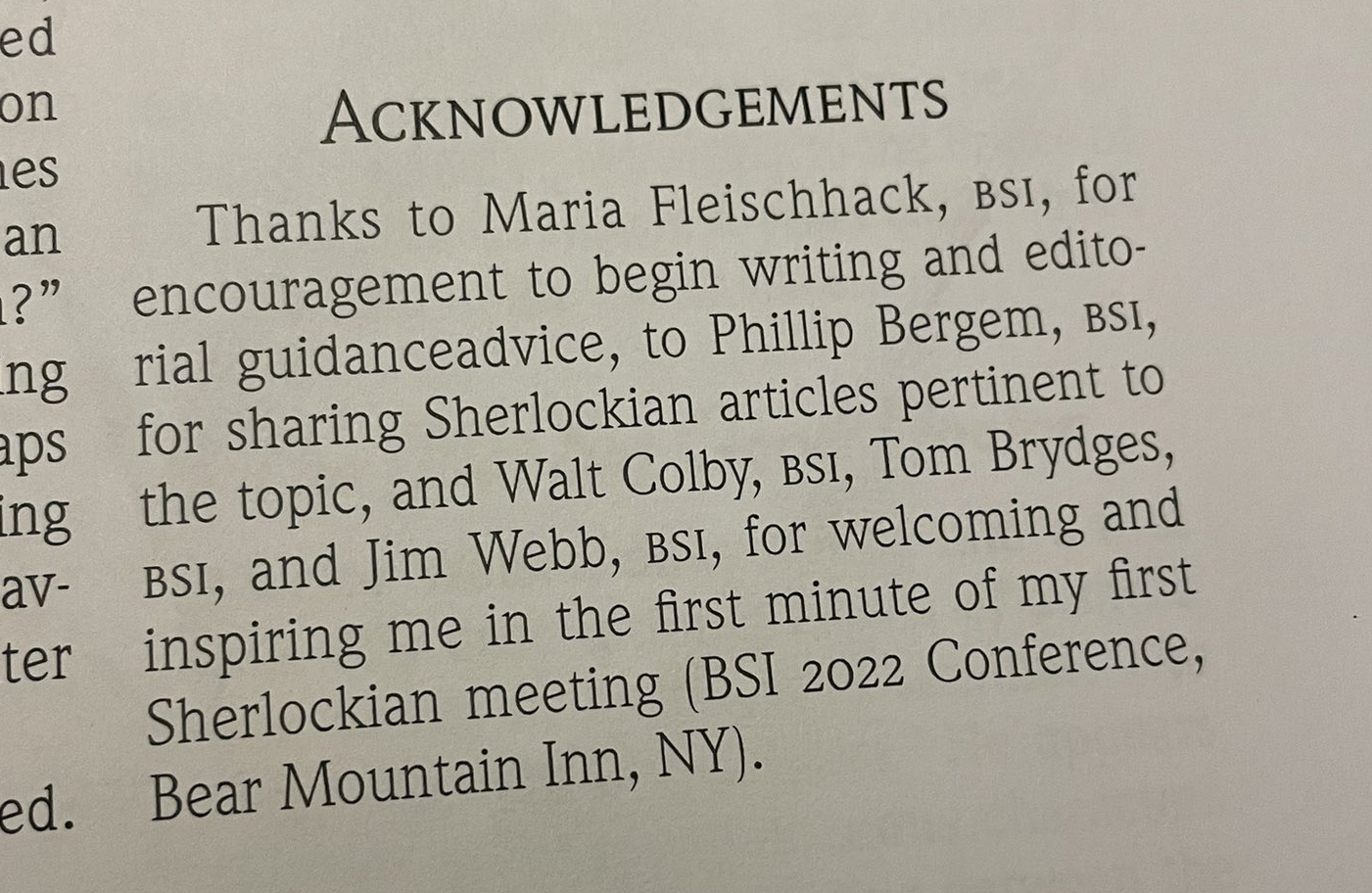
One important part I do want to highlight is my acknowledgements section. Maria Fleischhack spent time with me at the 2022 BSI Conference encouraging me to 'just start writing'. I was genuinely overwhelmed by the content of that conference, and couldn't imagine how I could possibly come up with anything 'new'. Maria also proof-read the article and provided comments for me. Phil Bergem was an incredible help, finding and providing articles he and others had written, and brainstorming on how to make sure I'd read the material out there on the topic of toilets and bathrooms in the canon. 

And finally, at my very first ever Sherlockian IN PERSON gathering (because I went to a lot of Zoom meetings during COVID), I walked into the Bear Mountain Lodge for that 2022 BSI Conference very intimidated. Everyone knew everyone and I knew no-one. I registered and walked up to the bar thinking I'd sit on my own and have a beer to calm my nerves. I didn't make it to the bar as Jim Webb introduced himself to me, then introduced me to Walt Colby and Tom Brydges, and the three of them invited me to join them for dinner. I went from nerves to welcomed in an instant and we had a long dinner and chat. I now know that their hospitality is not uncommon among Sherlockians, but I'll never forget their kindness to me. It was wonderful to see Jim and Walt last week at the 2024 BSI meeting, and while I sighted Tom we didn't get a chance to chat.

For them, I added this acknowledgement to my very first Sherlockian article:


Sunday, January 14, 2024

My Musgrave Monograph monomania - second version

This is a second updated version of my post on the Musgrave Monograph series. It includes some extra information and covers of all monographs I've been able to source. The first versino of the post can be found here: https://221bcooee.blogspot.com/2023/10/my-musgrave-monograph-monomania.html


My favorite scion publications come from the Northern Musgraves. Sadly, the Musgraves wound down 15 years before I discovered Sherlockiana. There were two primary periodicals published by the Northern Musgraves. The first was a regular newsletter called "The Ritual", and the second an 'annual' titled "The Musgrave Papers". Both publications contain absolutely outstanding Sherlockian articles, and many issues can easily be purchased on sites such as eBay.

There were a number of other Northern Musgraves publications. My favorites are the "Musgrave Monograph" series. Each publication is a short monograph on a single topic. While visiting New York I was lucky enough to spot a copy of the first Monograph at Otto Penzler's Mysterious Bookshop, and have now added a photograph. Please let me know about errors or other information you might have for this list - I've cobbled the list below together and have not found a complete list anywhere including in Northern Musgraves publications. The Northern Musgraves publications do carry announcements and reviews of the Monographs and I'll add some of that information. 

The Musgrave Monograph Series as currently determined.

Musgrave Monograph Number One. Pacing The Musgrave Ritual, Carol Whitlam, 1990. Fifty copies issued.


{No picture of cover found}

Musgrave Monograph Number Two. Diving down into the cellar : uses of photography in the canon, Matthew Booth, 1991. This cover image was provided by Matthew Booth, and is the original artwork by Kathryn White (one of the co-presidents of The Northern Musgraves).


Musgrave Monograph Number Three. "Ready when you are, Mr. Rathbone" : a review of the Universal Holmes films, Roger Johnson, 1995.

Musgrave Monograph Number Four. 'I looked in at Mecca ...': an insight into Sherlock Holmes' visit to Mecca, Anne Jordan, 1993. Reviewed in 'The Ritual' No 12 (Autumn 1993): "Anne divides her monograph into two sections: why Holmes might have wanted to visit Mecca, and, having arrived there, what he would have discovered... maps and illustrations are included in the text".

Musgrave Monograph Number Five. 140 different varieties : a review of tobacco in the Canon, John Hall, 1994. Reviewed in 'The Ritual' No 14 (Autumn 1994): "John Hall has managed to pull together all references to smoking, tobacco and other related topics in the Canon with consumate skill... there is also background information about the social attitudes to and practice of smoking, along with sections on Holmes the smoker, Matches, Snuff, Transport and Storage. 

Musgrave Monograph Number Six. The Misadventure of the Sherlock Holmes Pilot. An account of the making of the first pilot film for a Sherlock Holmes television series. Richard Launcelyn Green. 

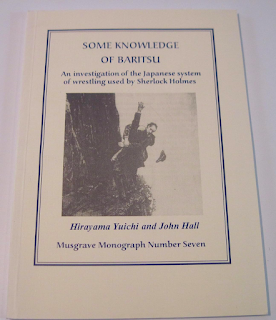
Musgrave Monograph Number Seven. Some knowledge of Baritsu: An investigation of the Japanese system of wrestling used by Sherlock Holmes, Hirayama Yuichi and John Hall, 1996. Reviewed in 'The Ritual' No 19 (Spring 1997): "Two leading Sherlockian writers.... review the various fighting techniques of jujitsu, bujutsu, aikido, sumo, bartitsu, and judo, and the influence of Japanese wrestling in Victorian London.... The monograph begins with a consideration of the possibility that Holmes may have visited Japan".

Musgrave Monograph Number Eight. Sherlock Holmes, Conan Doyle and the British Empire : an investigation into Conan Doyle's links with the British Empire as expressed through his Sherlockian and other literature, Jeffrey Richards, 1997.


Musgrave Monograph Number Nine. 221 BBC : writing for the world's first complete dramatised canon : (with some observations upon previous radio appearances of Mr. Holmes and Dr. Watson), Bert Coules, 1998. Reviewed in 'The Ritual' No 23 (Spring 1999): "His account begins with a thoughtful analysis of the radio careers of Holmes and Watson both in Britain and America up to the time of his own involvement. This began in 1987... Coules proceeds to give us a revealing and instructive insight into the making of radio plays."


Musgrave Monograph Number Ten. The somnambulist and the detective : Vincent Starrett and Sherlock Holmes, Susan Rice, 2000. Reviewed in 'The Ritual' No 27 (Spring 2001): "Rice has provided a fine overview of {Starrett's} five major Sherlockian works.... there are also assessments of Starrett's involvement in Chicago scions.... the monograph is rounded off by a comprehensive, if not exhaustive, Starrett bibliography".


NOT A MONOGRAPH

I'll also add a few publications here from Musgrave Monographs that are also chapbooks, but turn out to be one-off publications, rather than part of the 'Musgrave Monograph' series.


Sherlock Holmes and the Shadow of the Wolf. Ron Weighell, 1992. This is a pastiche, rather than a Sherlockian study. From Wikipedia: "In 1992, the Northern Musgraves... invited Weighell to produce a story for their ‘Aspects of Holmes’ weekend. The positive reception of The Shadow of the Wolf, read out at the society's annual dinner."

{No picture of cover found}

Guilty of several monographs : the published writings of Mr. Sherlock Holmes. John Hall, 1996. Given that other number is accounted for, it is possible this title was not part of the Monograph series.


Tuesday, January 9, 2024

Geographica Baskervillia. A rare publication? Maybe, maybe not.

I've been doing a LOT of Sherlockian reading on the Hound of the Baskervilles. There are a few reasons for this. It's certainly my favorite Sherlock story! I was lucky enough to visit Devon and the moors district for a day during the past summer including Buckfastleigh and the Cabell sepulchre (see information here : https://221bcooee.blogspot.com/2023/08/richard-cabells-sepulchre-in.html). Another reason I've been reading through articles and books stiuying HOUN is because I'm researching and writing a Sherlockian article... of course my goal is that it would be published in an eminent journal, but I recognize that I'm not amazing at writing 'studies' and we will see what happens. Anyway I'm reading a lot!!

That Cabell post mentioned above includes a list of HOUN studies, with my absolute favorite being The Hound of the Baskervilles, Hunting the Dartmoor Legend, by Philip Weller, and published in Devon, 2001. In my opinion the book is an absolute tour de force covering every aspect of the HOUN story, ACDs sources and inspirations, the Dartmoor setting, and color photographs of the Cabell sepulchre. I cannot recommend this book enough, and it includes the HOUN story itself. I should add there is a STRONG emphasis on identifying the real geographic locations in which the HOUN is set.

A lot of material has been published by Weller, and in seeking other studies by Weller that might exist on my obscure HOUN-related topic, and innocent search at Abebooks.com unearthed this publication, in a three-ring folder, of about 170 pages.

Geographica Baskervillia, A Dartmoor Workbook

Compiled by Philip Weller 

from The Hound of the Baskervilles

Published 2000


As can be seen above, the folder includes a cover letter that outlines the notation strategy. The 'Dartmoor Sherlock Holmes Study Group' appears to have been a sub-group of the Franco-Midland Hardware Company - a British society. A sample of Weller's textual analysis of location is shown below. It is incredibly detailed, with each phrase highlighting any locatino comments in purple, followed by commentary in green. Line by line!


The folder and document itself doesn't provide a great deal of detail on the context or background to this publication. Nor does the 'volume' provide any insight into the 'print run' for this compiled folder.

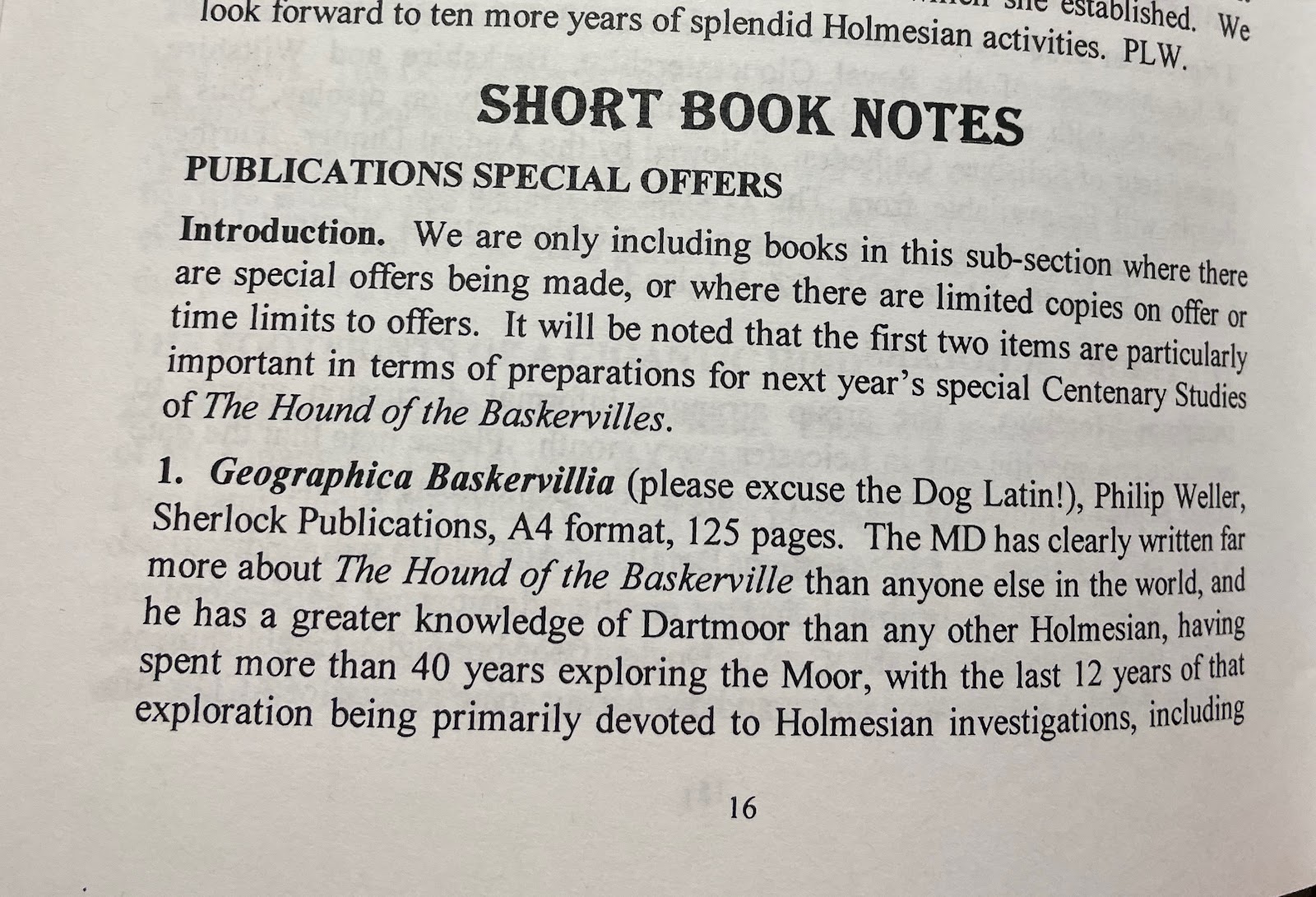
I turned to the publications of the Franco-Midland Hardware Company (FMHC) to find some information. I believe that Weller was the head of the FHMC (called the Managing Director of FHMC), and it published a dizzying number of different publications - including a "Memo" and "Newsletter" and a "Report" series. Sure enough, the August 2000 issue of the 'FHMC Memo' includes notes on books, including the Geographica Baskervillia. I've pulled out some quotes from the publication announcement in 'The FMHC Memo' for August 2000 (issue 7). As a side-note, my copy of the August 2000 Memo has an insert from 2002 apologizing about inactivity in publications of the FMHC.


Bolded emphasis in the quotes below are mine:

"The MD (Weller) has clearly written more about HOUN than anyone else in the world, and he has a greater knowledge of Dartmoor than any other Holmesian, having spent more than 40 yeras exploring the Moor, with the last 12 years of that exploration being primarily devoted to Holmesian exploration, including visits being made to every single building on the 369 square miles of the Moor... 

"Some of those taking part in the Hound Centenary Convention on Dartmoor have asked for copies of the MD's own special reference work on the canonical references to locations in the HOUN. This volume consists of 120 large-format (A4) pages and 50,000 words of text. Some 375 quotations are extracted from HOUN, each of which provides a clue to the geography of the case. The nature of the clue, or clues, in each quotation is/are discussed and cross-linked to other quotations bearing upon that aspect of the geography, and to real locations on Dartmoor which may have inspired the quotation. This is done using colour codings and page references to the Doubleday and Oxford editions of the case.

"It would be prohibitively expensive to have this material printed commercially, because of the colour-coding, but we are willing to produce copies of this unique reference work directly from a computer printer at cost price, for storage within a loose-leaf filing system. This is, in any case, the best way of storing this material, to allow for updates and the inclusion of other material. A lot of preparatory work will be required to set up this project, and we are only going to make this offer once, so this is your only chance of obtaining a copy of this work. 

"Please note that we originally had no intention of publishing this material, as it really is a labour of love, which has involved many thousands of hours of work to produce, so we really do not mind if nobody actually wants a copy.


This announcement provides context for the incredible research and effort that Weller put into his 'passion project'. How many people purchased copies? I doubt there were many, as it was only announced once in the 'FHMC Memo', but I'm pleased to have one to add to my small collection of HOUN-related Sherlockian publications.

Friday, January 5, 2024

Ouch! A title page review of The Italian Secretary

The shortest of posts! Browsing the shelves at Second Story Books in Rockville, I chanced to open a used copy of the Sherlock Holmes pastiche 'The Italian Secretary' by Caleb Carr. I remember struggling through this book on a flight after buying it at Heathrow Airport back in the late 90s. Really struggling.

So I felt validated by the previous owner who had decided to annotate the title page of their book: "The characters are neither Holmes nor Watson. The language is not Watson's either".

Brilliant. The book is still on the shelf at Second Story Books, and may be for quite some time!  


Wednesday, January 3, 2024

The dancing miners and their photographer

This is a post that I absolutely intend to evolve into a Sherlockian article somewhere.

The BSI International Series book "Australia and Sherlock Holmes" (https://bakerstreetirregulars.com/2009/01/04/australia-and-sherlock-holmes) contains an introduction by Bill Barnes and Doug Elliott highlights a wonderful Australian Sherlockian event - one of the first Sherlockian gatherings ever! 

The monthly Strand Magazine contained a delightful section titled 'Curiosities' that printed a range of submitted photos and anecdotes from readers. The August 1904 issue of the Strand leads its Curiosities section with a Sherlockian submission:


Curiosities

WHAT IS THE NAME OF THE MINE? Some miners in Australia have adapted the cipher of "The Dancing Men" given in the Sherlock Holmes story published in THE STRAND MAGAZINE for December, 1903, and have spelt out the name of their mine as shown in the photograph. Can our readers give the name of the mine? The photograph was sent to Sir A Conan Doyle, Undershaw, Hindhead, Haslemere. 

Some very nice Sherlockian work has taken place around this photograph. A search of subsequent issues of The Strand Magazine did not unearth a follow-up to this article providing the answer.

The excellent Passenger's Log journal first published two Sherlockian pieces on this photograph, in issues 6.3/4 (May/August 2003) and 7.1 (October 2003). These articles first examined the human cipher, showing that they people corresponded to 'LACESIGE'. There was no 'K' present in the original canonical cipher, and it is assumed a hard 'C' was substituted providing us with 'LAKESIGE'. The 'G' is in fact meant to be a 'D', with the two letters have mirrored cipher symbols. And so we have 'LAKESIDE'.
Discussion in the Passenger's Log articles in 2003 next turn to where this mine could be. There was a mining town or settlement of Lakeside near Kalgoorlie in Western Australia (which was a very active gold mining centre in 1903), and it was also found that a mine in Ballarat, Victoria was called Lakeside. 

More recently, the 'Baker Street Almanac' issues (which can be freely read here at http://www.greenbag.org/almanacs/BS/bsa.html) have included an annual update of activities from 'other' countries. The report for Australia in 2019 and 2020 by Bill Barnes makes a more categorical statement that "there was indeed a gold mine named Lakeside in 1903, near Kalgoorlie in Western Australia."

The articles also pointed out that the photograph represented one of the earliest known organized Sherlockian events. It also represents one of the first every Sherlockian photographs. If we look closely at the Strand article, we see one extra detail:


"From a Photo by H. Grose."

Who was H. Grose? If we can identify the photographer, we should be able to confirm the location of the mine.

While a fuller summary will ultimately be written up, the answer is that our photographer is Henry Hermon GROSE (sometimes spelt Herman). Around the time the photograph was mailed to ACD (early 1904), the following advertisement was placed:

 Kalgoorlie Miner (WA : 1895 - 1954)  
Mon 19 Oct 1903 


Henry photographed under the name "H. H. Grose", and his studios in the Western Australian gold-mining town of Boulder (adjacent to Kalgoorlie) were immediately next to the now-ghost-town of LAKESIDE. In 1946, to location of Lakeside was officially re-named to Lakewood. 

The Kalgoorlie region was harsh and remote, established during the 1890s. How harsh and remote? Here is Lakewood (Lakeside) today from Google Maps Satellite:


Henry Grose, our photographer, was born in Adelaide (South Australia) in 1874. In 1895 he arrived in Fremantle (near Perth) from Adelaide on the ship 'Rockton', and may have headed straight for Kalgoorlie/Boulder which was in the early day of a gold rush. In 1901 he was in Boulder, as the announcement of his wedding and confirmation of his wedding shows:

The Evening Star (Boulder, WA : 1898 - 1921)  
Fri 4 Jan 1901


In 1901 a book of panoramic photographs called "Boulder city and views around West Australia's great gold centre" was published by Orr's Emporium, using photographs taken by Grose. A newspaper article described the book thus: "The panoramic views... are probably the best ever taken in the district, and the other photographs all bear testimony to the skill of Mr. Grose".

Critically, Grose had many photographs of mines, batteries (used for crushing quartz to extract gold), and employees of mines, published in newspapers - the first in 1899 and the last in 1903 (with one exception of a garden photo in 1907). These published photos are all labeled with the "H. H. Grose" credit, and include at least one photograph of mines at Lakeside (the Leviathan Battery and Cyanide Plant, Lakeside):

 Kalgoorlie Western Argus (WA : 1896 - 1916)  
Tue 22 Apr 1902

Other photos of workers at the Leviathan by Grose may include our Sherlockians!


It appears that shortly after Grose took the 'Dancing Miners' photograph, he went out of business and became bankrupt in 1906. Grose may have abandoned commercial/professional photography at this stage - there are no further references to his photography, and some possible references to working in mines. It's also evident that Grose was a mason from notices in the newspapers, and a member of the Surface Workers Union (a mining union).

Henry had at least five children, two of whom were 'deaf-mute' according to newspaper articles.

Henry Grose died in July 1918, aged 44, and was removed from his home at No. 1980 Vivian-street, Boulder and buried at the Boulder Cemetery.

UPDATE: A kind member of 'Find A Grave' named Danelle Warnock went to the site and provided the two photos confirming there is not headstone for that plot (as is the case for most around). After Grose died, his wife and children relocated to the Perth area, which may explain why a gravestone was not later installed.


Left: Wide view of the grave plot. Right: The metal plot marker '618' is all the marks Henry Grose's grave.

I would be very happy to hear from anyone who comes across this blog post, with more information, or photographs taken by H. H. Grose of Boulder.


Sunday, December 24, 2023

Peter Blau and the future of the Sherlockian world

One of the very first blog posts I made described the presentation by Glen Miranker BSI at the Red Circle of DC. You can read more about Red Circle meetings at the official site (http://www.redcircledc.org) and for each meeting you can see Peter Blau's notes on each meeting.

At the June 2023 meeting of the Red Circle, the intended presenter was the actor Paxton Whitehead (https://en.wikipedia.org/wiki/Paxton_Whitehead). Sadly, Paxton passed away just days before the meeting, and the illustrious leader of the Red Circle, Peter E. Blau BSI, stepped up and presented. I'm embarrassed to say it took me six months to organize the recording into a formatted presentation and my good friend Kyle Brimacombe created a formatted recording. That recording has now been posted on Youtube, and is embedded into the blog post below.

The presentation itself includes a lovely introduction from Beverly Wolov and Ross Davies BSI. They are costumed in Peter Blau's trademark powder blue blazer and tie embroidered with "Snoopy the detective" (created by Bev Wolov specifically for Peter). 

 
Left: Ross Davies and Bev Wolov dressed as Peter and introducing Peter. Right: Close-up detail of Peter's hand-embroidered signature tie.

Peter's talk was entitled "The Future Lies Ahead" and recalls his more than six decades as a Sherlockian. It's a very enjoyable talk and worth watching both for the content and for an opportunity to see Peter's personable and comedic style.

 The video can be accessed directly at : www.youtube.com/watch?v=egBds8GZVus  

A new edition of the Baker Street File - 2026

I've previously written about The Baker Street File created as a guide for the filming of the Granada series, and its edition published...