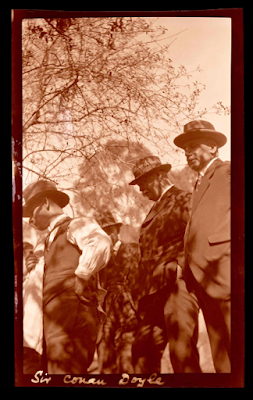
Figure 5. Photographs of "Sir Conan Doyle" at Humbug Scrub. Left: holding the possum. Right: ACD at center, with his private secretary Major Alfred H. Wood at right. Source: South Australian Museum Waite Collection AA 356.
The Verities of Nature.
[Written for The Register by Sir Arthur Conan Doyle.]
Before ever I reached Australia there was one man whom I had made up my mind to see. This was Mr. Bellchambers. I had read an account of him in some English magazine, and I knew him to be one of those men who were very close to Nature, who loved her as their mother, and who found in her communion a treasure which no worldly success could equal. Now I have not only met him, but I have seen his little domain out in the Humbug Scrub (is it too late to alter the name of that unlucky tract of country!) I will not easily forget my day.
Bellchambers is a mixture of the New Forest Brusher (see Note 16), a famous character whom I knew in my youth, who lived and died in a bark hut in the forest, and Thoreau, the American philosopher. He is half-way between those points — more refined than the first, less literary than the second. He is a kind-eyed, -unkempt man in the fifties, with no thought of appearances, but with the look and the voice which bespeak the gentle soul within. There is the real gentleman — that much-abused word; the man too gentle to be harsh to living creature, or to take pleasure in slaughter.
"Yes, I am mostly vegetarian, except fish," said he; "you see, I know the beasts so well that I can't bring myself to pick their bones."
I have come back from a long day with mixed impressions. There are vivid colour impressions — deep green of the Australian spring; late grey of eucalyptus trunks with untidy moulting bark; light yellow of budding wattle; purple pink of the carpet of knot grass; and everywhere the familiar home flowers, but all a little altered in their new home — the dandelion, the buttercup, the mustard plant, each imprinting its tiny yellow dot upon the variegated ground work of Nature.
Of my conversations, too. I had the same mixed impression. It was nature-talk. We spoke or those things which may seem slight to the world, and yet are more permanent than thrones and dynasties. I learned of the strange storks — the "native companions" who meet 500 at a time for their stately balls; of the bower birds who decorate their homes with glass and pebbles; of the little Ted beetles who fertilize the insectivorous plants without being eaten like other insects; of all manner of nature secrets. Some deep things were drawn from Mr. Bellchambers's store of knowledge.
"Birds have more sense than animals. They understand yon, like. They know what you mean. Snakes have least of any. They don't get friendlylike the same way."
Then I have the same mixed memory of the things I have seen. A blue-headed wren; an eagle soaring in the distance; a hideous lizard with a huge open mouth; a laughing jackass which refused to laugh; many more or leas tame wallabies and kangaroos; a dear little 'possum which, got raider the back of my coat, and would not come out; noisy mina birds which fly ahead and warn the game against the hunter. Good little noisy mina! All my sympathies are with you! I would do the same if I could. This senseless lust for kitting is a disgrace to the race. We of England cannot preach, for a pheasant battue is about the worst example of it. But do let the creatures alone unless they are surely noxious! When Mr. Bellchambers told us how he had trained two ibises — the old religious variety — and how both had been picked off by some unknown local "sportsman," it made one sad.
We had a touch of comedy, however, when Mr. Bellchambers attempted to expose the egg of the malice fowl. He scraped into the mound with his hands. The cock watched him with an expression which clearly said — "Confound the fellow! What is he up to now?" He then got on the mound, and as quick as Mr. Bellchambers shovelled the earth in he kicked it back again, Mr. Bellchambers, in his good-humoured way, crying — "Get along with you, do!" A good husband is the mallee cock, and looks after the family interests. But what we humans would think if we were born deep underground, and had to begin our career by digging our way to the surface, is beyond imagination.
Might I, a visitor, take the liberty of giving a word of advice to the Government of this beautiful State? In Mr. Bellchambers you have a very rare and valuable man. Yon are wasting him. I have travelled far, and I know that both in Canada and the United States, by the time that Nature reservations have occurred to the powers that be, they have become economically impossible, save as spots so far from centres of population that they are useless to the average man. Here you have the very thine within, a drive of Adelaide. My advice is this. Let the State acquire several blocks round Bellchambers's area, and let the whole be enclosed. Let him be ranger with adequate remuneration. Let the roads connecting up be improved. All this would cost very little; but see what you would have in return! You would have a show place which folk would come from far to see. You would have a wonderful pleasure resort for the people of Adelaide. Finally, you would leave in the very best and most loving hands those numerous birds and other creatures which are seriously threatened with extinction. Do this, and your grand children will extol your wisdom. Don't do it, and in 10 years it will be too late.
No account of my day could be complete which did not acknowledge the company and teaching of Mr. E. R. Waite, Director of the Museum, who placed his stores of knowledge at my disposal. I admire learning, but I admire still more a man who Is a man; and when I learned that this gentle naturalist had gone down 60 ft. in Sydney Harbour to steal the egg of a shark, I took off my hat to him. That's a form of bird-nesting that's worth doing.
In this brief account for the newspapers Doyle wrote “I admire learning, but I admire still more a man who is a man”. This provides some key to what drew Doyle to Bellchambers. Bellchambers was certainly the central non-spiritualist interaction of ACD's time in Adelaide. A number of artefacts likely remain to be tracked down from Doyle’s naturalist jaunt. The first is ACD's "closely-written six pages of copy" for the Register - does this survive? Similarly, the sanctuary kept a visitor's book that ACD signed (Note 17), does this book survive? ACD's visit resonated in Adelaide for many years. A 1953 interview with press photographer W. Sidney Smith (aged in his 80s) shares that "Among Mr. Smith's treasures is Sir Conan Doyle's book, The Wanderings of a Spiritualist, autographed and sent him by the author in October, 1921... He readily gave Conan Doyle permission to use in photographs in the book" (Note 18). This copy of the book is possibly still sitting on a shelf in Adelaide.
ACD's visit to Adelaide left a lasting legacy on the reputation of Bellchambers and his sanctuary, and T.P. Bellchambers clearly left an impression on Conan Doyle. Earlier in his literary career, Doyle wrote stories (The King of the Foxes, 1901) and poems (A Hunting Morning, 1898) celebrating the thrill of hunting foxes. It is remarkable then to read of Doyle lamenting that “This senseless lust for killing is a disgrace to the race.” Did Bellchambers influence Doyle’s attitudes to hunting for recreation? A tribute from Doyle lies in ACD’s third Professor Challenger novel in 1926/ The "Land of Mist" tells a tale in which scientific empiricism is applied to shine a light on the spiritualist phenomenon. In the book, three men spend a night investigating a haunted home in Dorsetshire, owned by Mr. Belchamber.
References
Note 1. I am using the 1988 reprint published by Ronin Publishing, Inc. Berkeley CA.
Note 2. Phillip Bellchambers, "The Wizard of Humbug Scrub, The Story of Thomas Paine Bellchambers 1858-1929", self published, 1998. Author's copy.
Note 3. T. P. Bellchambers, "Nature: Our Mother (Reprinted from the Saturday Journal)", W.K. Thomas & Co., Adelaide, 1918. Digital copy available at National Library of Australia.
Note 4. T. P. Bellchambers, "A Nature-Lovers Notebook", The Nature Lovers League, Adelaide, 1931. Author's copy.
Note 5. T.P. Bellchambers, "Hindmarsh Island Long Ago", The Register (Adelaide, SA), Tue 16 Apr 1918, page 6. Digital copy available at National Library of Australia: https://trove.nla.gov.au/newspaper/article/60350215
Note 6. The Area's Express (Booyoolee, SA), Tue 15 Jan 1884, page 3. Digital copy available at National Library of Australia: trove.nla.gov.au/newspaper/article/218913329
Note 7. The Express and Telegraph (Adelaide, SA : 1867 - 1922) Tue 6 Dec 1887, page 2. Digital copy available at National Library of Australia: trove.nla.gov.au/newspaper/article/207711436
Note 8. Illustrated London News, Sat 24 Jan 1925.
Note 9. Observer (Adelaide, SA), Sat 27 Jul 1929, page 16. Digital copy available at https://trove.nla.gov.au/newspaper/article/164896515
Note 10. SA Newspapers: Pen names of SA journalists and cartoonists, maintained at State Library of South Australia: https://guides.slsa.sa.gov.au/sanewspapers/pennames
Note 11. Rufus, "Mr. Bellchambers at Home. Visited by Sir Arthur Conan Doyle". The Journal (Adelaide, SA), Sat 2 Oct 1920, page 11. Digital copy available at National Library of Australia: https://trove.nla.gov.au/newspaper/article/200888266
Note 12. Arthur Mee (1875-1943), English writer, journalist and educator. Published a range of children's periodicals and encyclopedia's including The Children's Encyclopædia which ACD contributed articles to.
Note 13. Observer (Adelaide, SA), Thu 17 Jul 1930, page 53. Digital copy available at National Library of Australia: trove.nla.gov.au/newspaper/article/164797612
Note 14. The Register (Adelaide, SA), Fri 1 Oct 1920, page 7. Digital copy available at National Library of Australia: https://trove.nla.gov.au/newspaper/article/57918477
Note 15. Observer (Adelaide, SA), Sat 9 Oct 1920, page 25. Digital copy available at National Library of Australia: https://trove.nla.gov.au/newspaper/article/165911424
Note 16. New Forest Brusher, also known as ‘Brusher Mills’ was Harry Mills (1840-1905), a resident of the New Forest in Hampshire England. Mills was a snake-catcher who lived in the forest and made his living catching snakes, and became a local celebrity. New Forest was a matter of miles from Portsmouth where Conan Doyle resided for eight years, and based on the phrase ‘whom I knew in my youth’ it is possible Conan Doyle sought out and met Mills.
Note 17. The Mail (Adelaide, SA), Sat 24 Sep 1927, page 1. Digital copy available at National Library of Australia: https://trove.nla.gov.au/newspaper/article/58530391
Note 18. The Advertiser (Adelaide, SA), Fri 6 Feb 1953, page 4. Digital copy available at National Library of Australia: https://trove.nla.gov.au/newspaper/article/48301772